Summer solstice
Under Your Spell: A Romance Boxed Set of Masked Balls, Haunted Gardens, Magic, and MoreSummer solstice is more than a calendar marker in the novel. It is the longest day of the year and the night with the shortest duration, but it also becomes a recurring threshold between ordinary life and supernatural possibility. Characters attach to it ideas of alignment, travel, cemetery lore, dreams, and destined connection, so that a date which begins as pleasant seasonal conversation gradually becomes a structural signal for revelation and fate.
Astronomical Meaning and Seasonal Pleasure
Summer solstice is first explained in concrete, physical terms. The day offers more light than any other day of the year, while its night is the shortest, making it an occasion of abundance and duration. Its appeal is initially expressed through ordinary sensory pleasure: summer air is described as sweet, like honeysuckle, and the season seems especially inviting because daylight lingers.
The solstice also carries a cosmic dimension. The stars and planets are said to have aligned correctly, giving the date a poetic quality rather than leaving it as a neutral astronomical fact. That language turns seasonal brightness into a pattern that appears ordered and meaningful. The speaker names Summer solstice as one of two favorite days of the year, pairing it with Winter solstice and establishing the solstices as personally and symbolically privileged points in the calendar.
A Threshold Between Life and Death
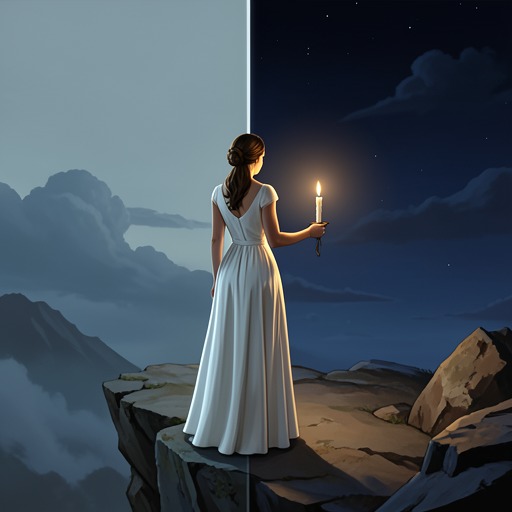
The date acquires supernatural significance through cemetery lore. It is described as a good time to visit a cemetery because spirit energy is believed to be especially strong then. According to the legend, the solstice functions as a bridge between the journey of this life and the next. The image gives the date a doubled character: it is the height of earthly summer, yet it opens toward death, memory, and whatever lies beyond the visible world.
Belief remains deliberately unsettled. When asked whether the cemetery legend is true, the speaker does not claim certainty; instead, he acknowledges that he has no evidence disproving it. This skeptical qualification preserves a tension between rational doubt and imaginative openness. The solstice therefore operates within the novel’s broader uncertainty about the supernatural: it is not presented merely as proven doctrine, but neither is it dismissed as meaningless folklore.
The Solstice and Human Connection
The date becomes intimate when it is linked to journeys and reunion. Before a departure by ship, the solstice is invoked as a favorable time for travel because spirits are believed to be active and the air filled with energy capable of helping spirits find each other. The idea offers emotional consolation at the moment of separation. Even a skeptical listener is moved by the possibility that the universe may contain a principle of connection stronger than distance.
This language also frames a meeting as destined rather than accidental. A likeness between two people prompts the claim that their encounter was meant to happen, followed by the suggestion that the stars aligned correctly. The solstice thus supplies a vocabulary for romantic recognition: cosmic alignment becomes a way to interpret resemblance, attraction, and the sudden sense that two lives have been brought together by forces beyond deliberate choice.
The same association recurs in a more physically tender farewell. When Lavinia Lockett Sewall is preparing to part from Theodore Sewall, he reminds her that the day is Summer solstice and again describes it as a favorable time for journeys and spiritual reunion. His belief gives the impending departure a ritual frame. The separation remains painful, but the date transforms it from a simple loss into a passage whose invisible connections may endure after the ship leaves.
Recurrence, Memory, and the Hidden Manor
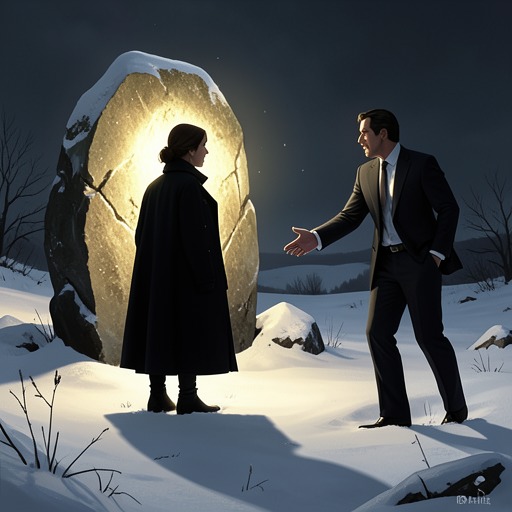
The solstice later becomes a key to chronology and supernatural recognition. Julia recalls seeing the manor two years earlier in summertime and identifies the date as June 22, which is confirmed as the solstice. She does not disclose that the date is also her birthday, leaving part of its personal significance unspoken while the conversation turns toward the house and its rumors of haunting.
The date connects Julia’s vision to a dream experienced by Paul E. Willingdon. Paul says that he dreamed about Julia on the same day she saw the house. He further explains that the view in her painting cannot be reached by any physical trail: a 100-foot rock face stands before the forest, and he knows this because he has been there himself. The coincidence of date, dream, and impossible perspective changes the solstice from a symbolic backdrop into a recurring condition of perception. What Julia saw and what Paul dreamed appear to belong to the same unexplained pattern.
Paul places that pattern within the Willingdon family’s history, saying that the phenomenon has existed for at least five generations, or six if he counts himself. The solstice consequently links individual experience with inherited tradition. Its recurrence suggests that the date does not simply inspire people to interpret events romantically; it may actively mark moments when hidden places, dreams, and destined relationships become accessible.
Narrative Significance
Across these episodes, Summer solstice moves from pleasant daylight to sacred threshold, from seasonal conversation to evidence of a larger supernatural design. It governs contrasts that recur throughout the story: the maximum of light alongside the minimum of darkness, earthly travel alongside spiritual passage, skepticism alongside belief, and private memory alongside a family pattern lasting generations.
Its most decisive function is to make coincidence narratively legible. A meeting, a departure, a birthday, an impossible view, and a shared dream can remain separate facts, or they can be read as points arranged by alignment. The solstice supplies the story’s recurring occasion for choosing the second interpretation. It does not erase uncertainty, but it gives uncertainty a date, a season, and a recognizable threshold through which love, memory, and supernatural revelation can pass.